Showing posts with label Reproduction. Show all posts

06 October 2022

B10.3. Sexual reproduction in humans

 (0654) Coordinated Sciences 2023/2024


Subheadings and key concepts covered

  • anatomy of the
    • male reproductive system: prostrate glands, sperm ducts, urethra, penis, testis, scrotum
    • female reproductive system: ovaries, oviducts, uterus, cervix, vagina
  • fertilisation
  • structural adaptations of the sperm and egg cells
  • the menstrual cycle
  • pregnancy:
    • zygote, embryo
    • functions of: amniotic sac, amniotic fluid, umbilical cord, placenta
  • STIs & HIV/AIDS
    • how they spread
    • how to control their spread


B10.1-2. Asexual reproduction & Sexual reproduction in plants

(0654) Coordinated Science


Subheadings and key concepts covered

B10.1. Asexual & sexual reproduction: 

  • virus (binary fission), plants (runners, bulbs, tubers)
  • haploid cells, diploid cells, zygote
  • advantages and disadvantages of either mode of reproduction

B10.2. Sexual reproduction in plants

  • flower anatomy: sepal, petal, stamen, carpel
  • pollination: wind and insect-pollinated plants; their adaptations
  • fertilisation
  • investigating conditions for germination: water, oxygen, warmth


03 April 2014

#124 Gonorrhoea

Gonorrhoea bacteria,
Credit: Science photo library
Gonorrhoea is caused by bacteria that can be passed from one person to another during sexual intercourse. Neisseria bacterium is a small, round cell. It can only survive in moist places, such as tissues lining the tubes in the productive systems of a man and a woman. 


02 April 2014

#123 HIV/ AIDS - transmission and prevention methods

AIDS (Acquired Immune Deficiency Syndrome) is a disease caused by the HIV. 
HIV can not live outside the human body. It is an especially fragile virus  - much less tough than the cold virus. 

It is transported in body fluids. You can only become infected with HIV through direct contact of your body fluid with those of someone with the virus.


#122 Breast feeding vs formula milk?

This has been a tough question for many years: Which is better - breast milk or fomula milk? While breast milk is nutritious, it has its inconveniences. Formula milk is convenient but expensive. What to choose? 


#121 Artificial insemination, hormones in fertility drugs


An artificial insemination procedure uses a thin, flexible tube (catheter) to put sperm into the woman's reproductive tract (vagina, cervix, uterus) around the time of ovulation. For some couples with infertility problems, insemination can improve the chances of pregnancy.


#120 Method of birth control

There are 4 main groups of birth control methods: natural, chemical, mechanical and  surgical. 


#119 Sex hormones

Credit: revision world
Sex hormones (testosterone in boys and oestrogen in girls) are responsible for the development of secondary sexual characteristics at puberty. 


#118 Process of birth

Birth begins when the strong muscles in the wall of the uterus start to contract. This first stage of birth (called labour) is triggered by the hormone oxytocin.


#117 Antenatal care

Ante-natal (before birth) care is a routine care for the healthy pregnant woman.


16 March 2014

#116 The development of the fetus

Credit: thomasreynoldsblog
The blastula develops into an embryo and some of the cells form a placenta, linking the embryo with the uterus lining. Organs such as the heart develops and, after 8 weeks, the embryo is called a fetus.


#115 Formation of the fetus - fertilisation, implantation

After sexual intercourse, sperms swim through the cervix and the uterus into the oviducts, where they meet an egg. One sperm may fertilise the egg to produce a zygote


#114 Menstrual cycle

The menstrual cycle in women is a recurring process in which the lining of the uterus is prepared for pregnancy, and if pregnancy does not happen, the lining is shed at menstruation. The cycle lasts about 28 days.

#113 Reproduction in humans - Reproductive system

Reproduction in humans is when the male gamete (sperm) fuses together with the female gamete (ovum/egg).

At first, it is just one single cell, which duplicates over and over until after 9 months…… TA-Dahh! - A baby is born!


#112 Growth and development

Growth - permanent increase in size and dry mass, by an increase in cell number or cell size or both.

Development - increase in complexity 


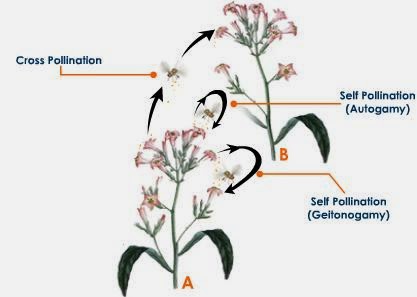
#111 Self-pollination and cross-pollination

Credit: TutorVista
Self-pollination - transfer of pollen from the anther to the stigma of the same flower, or to another flower of the same plant.
Cross-pollination - transfer of pollen from the anther of a flower to the stigma of a flower on a different plant of the same species.


15 March 2014

#110 Seed dispersal

Nutmeg is dispersed by birds.
Photo credit: r
ussolab.unl.edu
The flowers produce seeds which can be dispersed by the wind or other animals, providing a means of colonising new areas.


#109 Formation of seed, conditions affecting germination

The fertilised ovule divides by mitosis to form a seed containing the embryo plant and food stores called cotyledons.


#108 Structure and functions of a flower

You need to be able to describe the structure and functions of a named dicotyledonous (two seed leaves) flower.


#107 Reproduction in plants - agents of pollination

Reproduction in flowering plants may occur both sexually or asexually.

Pollination can take place with the help of agentswind or insects.